joi, 25 august 2016

Istoria in Miniatura (History in miniature)

This was the title for a meeting between Romanian figurinists at an old chateau in Valcea county-Romania.
The chateau named conac in Romanian was the property of Balcescu family from Valachia, the part of Romania south of the Carpathian Mountains. Nicolae Balcescu played an important role in the formation of modern Romania.

In this idyllic setting near an old wooden church moved here from another village, with all that luxuriant green forests surrounding us, we gathered at the initiative of Nicolae Mihai, researcher at the Romanian Academy and a very dedicated figurine painter, being hosted by Mr. Antonie Chelcea, director at the Nicolae Balcescu's Memorial.

Some of us have been accompanied by our families and despite our fears they had a great time in the vast yard, playing sports and benefiting by the very clean and healthy environment.

The hosts have been at their highest level, all the personnel doing their best for us to feel as good as possible. We also visited the museum that has many well preserved pieces of art and history, conserving a certain feeling from an old and mysterious period.

The theme of the meeting was to paint an Arab archer bust, beautifully rendered by Mario Numitone.
As you can see in the pictures, two of our fellows are sculptors and they had a great time too, regardless our most stupid requests.
A novelty by all means was a representative of the graceful gender, miss Ileana Sadean (https://www.facebook.com/ileana.sadean.3?fref=ts), a well acquainted miniaturist that is creating all kinds of subjects from A to Z, completing very well the diversity and complexity of this domain.
As a treat for guests, visitors and hosts, a small area was dedicated to the exhibit of some of the latest works of the participants. It was a surprise also for us.

By far the kids were the most excited for being able to paint plastic soldiers and model tanks generously offered by Cristian Florescu (http://www.ww2germans.com/)

There had been 3 demonstrations by Catalin Balta - "Making model trees", Bogdan Papuse - "rendering moss on rocks and trees" and myself - "painting a face with oils on an acrylic base".

The atmosphere was great, and the artists that were staying at the location worked till late in the night, with no one to tell them to stop.

In the end the official sponsor http://www.machete.ro/ presented us with useful gifts to keep up working and dreaming on new projects.

Back home I made some new pictures to my bust and now I'm waiting for a few free minutes to pick his lints, give him a matte laquer and enhance the last details.

marți, 21 iunie 2016

The near jungle

It's rather unusual to think that you can drive 1 hour from Bucharest and find yourself in a jungle, fishing like on Nature Channel.
In the movie you can see and hear what I mean.
The location is on the Danube, at Giurgiu.
It was marvelous to cross this piece of forest in the morning, listening to the birds anf angling hear and there to catch an asp. Well, not even one was willing to cooperate.

https://www.youtube.com/watch?v=VII6ryKJlmU

miercuri, 25 mai 2016

Red reflecting light - when figures are finished

In most of the cases when I present a figure, especially one with red clothes I get the same reaction from fellow modellers – “The red should be more modulated” or “there are not enough lights on that red” or “you should apply who knows which technique no.23” or just plain and simple, “let me know when you will finish this figure”.
First of all, there is not such a thing like finishing a painting. There are not a number of screws that you should put in place and when you finish them it means you have finished the work. Sometimes, parts of an artwork are left unfinished by artists with a purpose, but it’s not the case here. I remember I saw in progress work of some much respected painters thinking they should stop much earlier than they actually did.
Now in the particular case of red, we are talking about a color that due to the fact that is reflecting light so powerful tends to “eat” the fine graduations of light. A matte red surface will not reflect light as other colors, but with a higher intensity of that red. This mean there will be not pink or even orange, but just an intense light tone of red (scarlet, vermillon). You can see that in real world and also in paintings. In fact I guess the problem is that as long as painters try to reproduce a real world image, most often modellers are replicating other figures, painted by other more experienced modellers or are applying a set of techniques that have become a rule, a trend for anyone that want to count in jury’s eyes.
Bellow, see how different tones of red is reflecting light in real life, in paintings and in figurines.

Buy yourself a tube of light cadmium red or scarlet. Yes maybe it's not on the list at your course (class), but when you leave there you are allowed to think with your own brain.
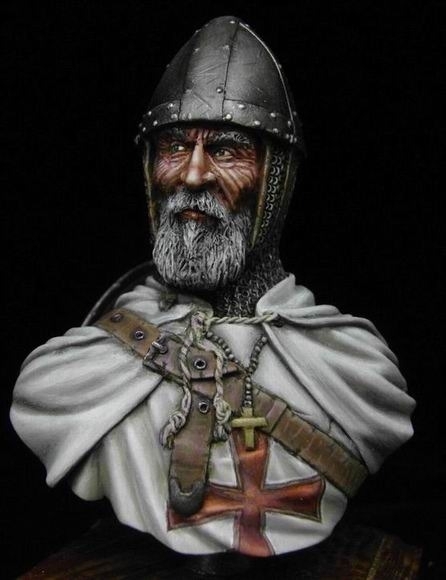
The same logic applies to faces. It seems that the vast majority of figurine painters are applying a set of techniques and a way of working the different plans of light and shade, as has been explained by some renowned painter. While this might be o.k. for bigger surfaces, in the particular case of small wrinkles and accidents of the surface, namely veins, scratches or scars, treating them with the same technique will inflate those details making the figure to look like a ceramic doll, with salami like limbs. It may be a question of taste but I try hard to avoid this.
To illustrate my opinion I took some arbitrary examples from the internet belonging to artists I don’t know. I will not post an image of one of my figures because I’m not trying to say that what I do is perfect, just that maybe I’m following a different ideal than others.

The only painter that didn't comply with the trend and did a wonderful job in my opinion is the author of the soviet soldier bust.
Stop puting those lights under the wrinkles starting down from the nostrils ! There should be shadow there, or at least a dimmer light. Same at the bags under the eyes. If you treat every wrinkle there with shadow and light, every kid will end up looking 90 years old. Wrinkles are volumes not colors.

marți, 24 mai 2016

Spring changes

An old friend of mine..... Well he is not older than me. What I meant is that I guess he's knowing me much than anyone else. Well, Andrei has listen to me how I was complaining about not being able to manage all my different works and parts of my life and personality and in the end he told me: Why not putting all together in a single place. In fact all those things are describing you as you are.
This might be a relief. Maybe I will disappoint some of those who are visiting this site, but on the other hand I guess you will pick out just what you are interested in.
Anyway, I hope that this will at least ensure a better pace of posting.
So, hold on ! You will see here all kinds of models, figurines as usual, dioramas, paintings, fishing and thoughts. Hope I will like it. Because if I will like it, there is a good chance that you will like it too.

miercuri, 10 februarie 2016

Prussian Infantryman 75mm Bestsoldiers

I had some time just for my figurines so I started in a hurry to put together and paint this last acquisition. Why not completing the bunch of old ones ? Who knows ?!... I will get to them too, eventualy.
As for many of their kits BS offers 2 heads. The one with the helmet is closer to the image in my head but unfortunately it's not so well rendered as the one with the kepi.


In fact the original picture that inspired the model is of a sergeant with kepi.


BestSoldiers provide an extra helmet to be hanged by the dagger handle. I thought a long time if it's worth to transform the head with better anatomy, to receive the extra helmet. To much of a surgery and that to the cost of loosing one option in the end.
The anatomical proportions are good but the different parts of the figure are not coming together so well. There was also places where I had to sculpt to get to a credible look.
For the missing baionette scabbard I found a replacement that I mildly sculpted from a piece of white metal (a former horse harness I guess).

The base was very simple, giving the possibility to add whatever details you want. In the same time the small surface prevented me to over-detail it (this time, at least). I opted for a ruined village environment, bearing in mind that the Franco-Prussian war was fought in a populated Europe of the mid 19th century.
For the first time I give it a try with the very expensive Valejo black primmer. It's qualities doesn't impressed me too much, functionally speaking. It was useful on the figure overall but where carnation was to be painted it was worse than anything else.
Furthermore I wanted to (re)experiment with Humbrol basecoats, for face and hands, which was airbrushed. The result was OK at one stage, but in the end I didn't like the cyanotic effect. This is still apparent on the finished figure, more so if it's sided by a conventional primed figure.


In fact I had to rework the skin two times to get a satisfying result.
The rest of the figure was painted in my usual manner, with acrylic base coats and oil modulations of shadows and lights.
As I said in the beginning, the great thing is that you can display the finished figure with both heads.